Recommended
FLEXIPAX SDK
Your own passenger app
Keys inside the app passengers already use, under your brand. They never have to leave it.
How the SDK worksPassengers open their cabin with their phone. The key lives inside your own passenger app or ours, and works with compatible Bluetooth cabin locks.
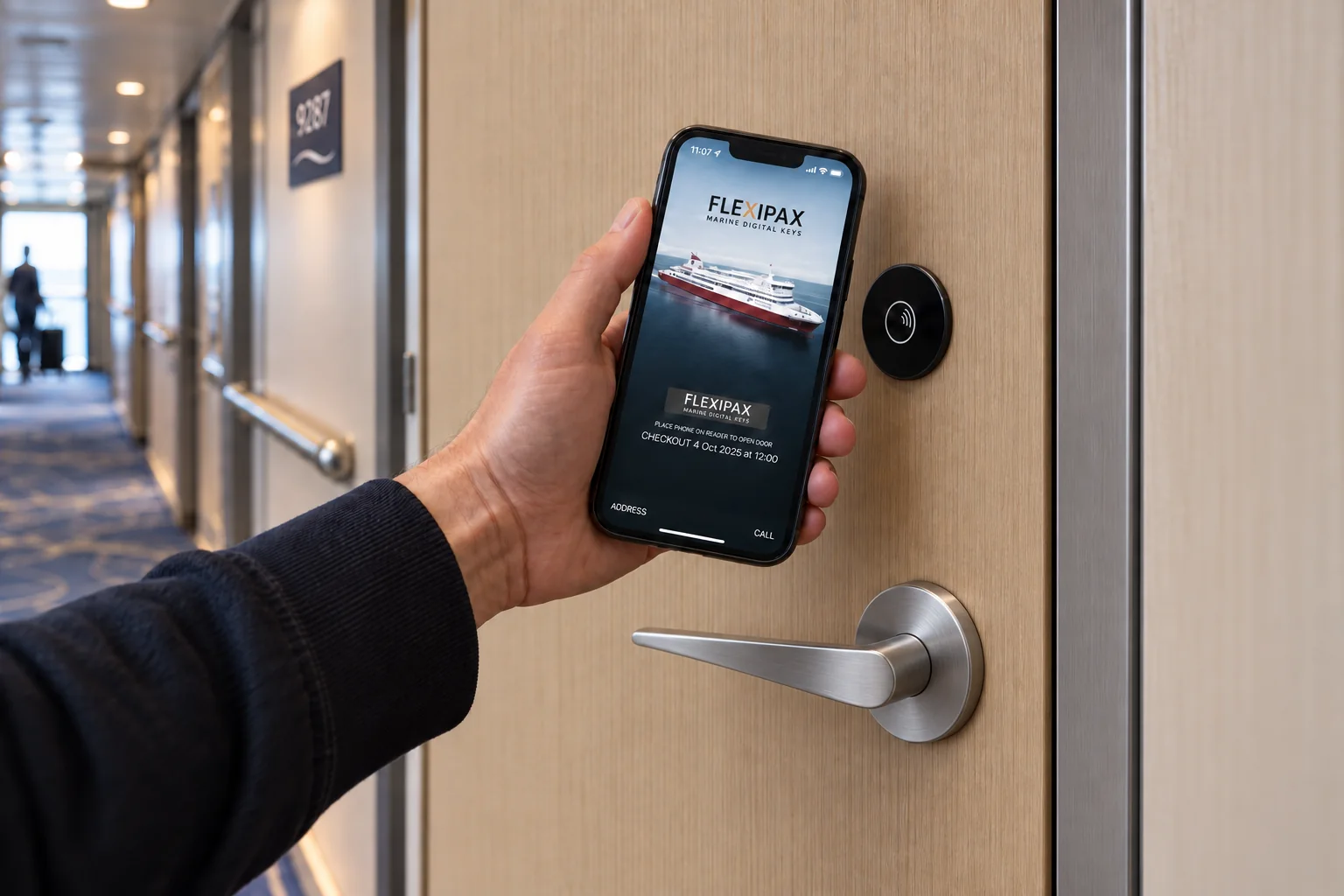
A digital cabin key stored on a passenger’s smartphone. It opens a compatible Bluetooth cabin lock and is connected to your reservation system, so each passenger gets the right cabin for the right stay.
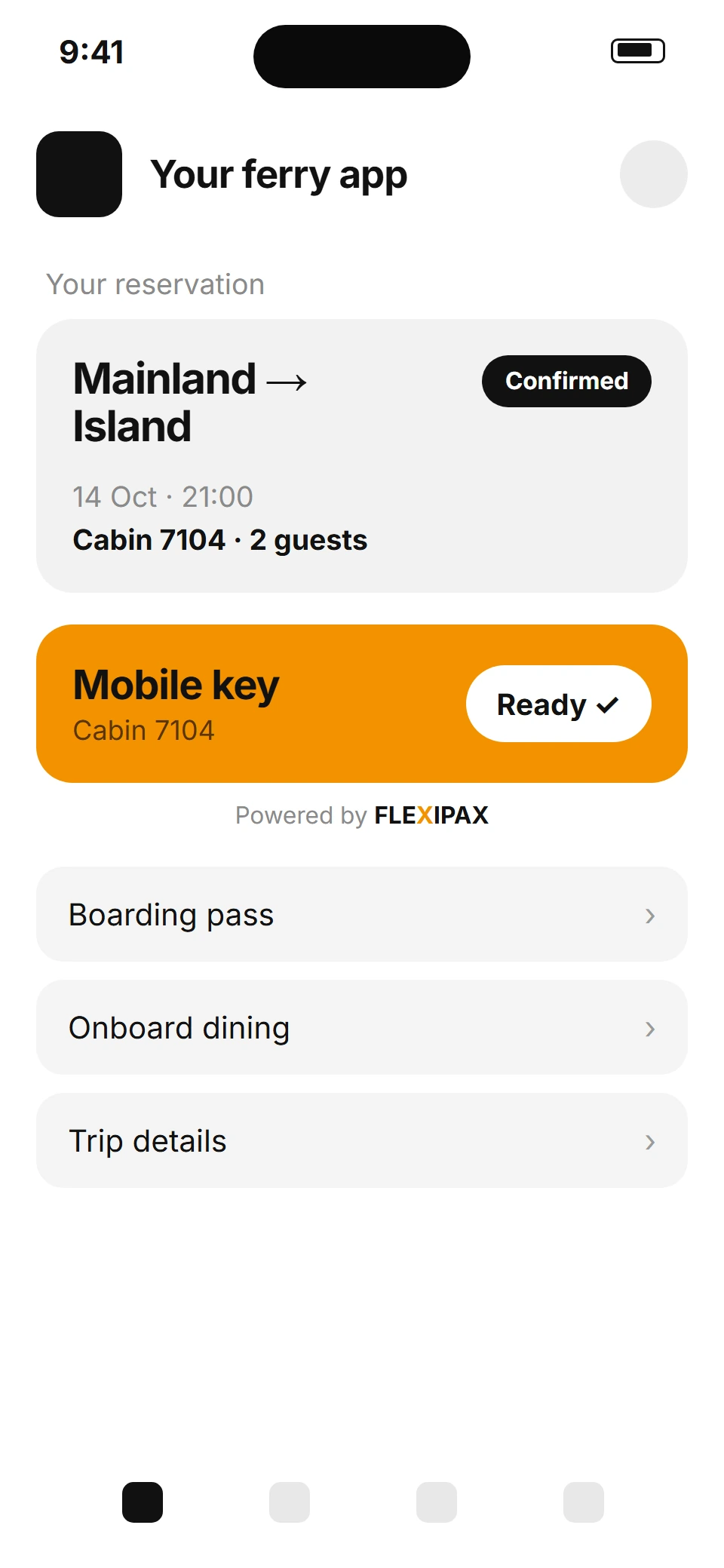
The mobile key appears in the passenger’s app, next to the reservation.
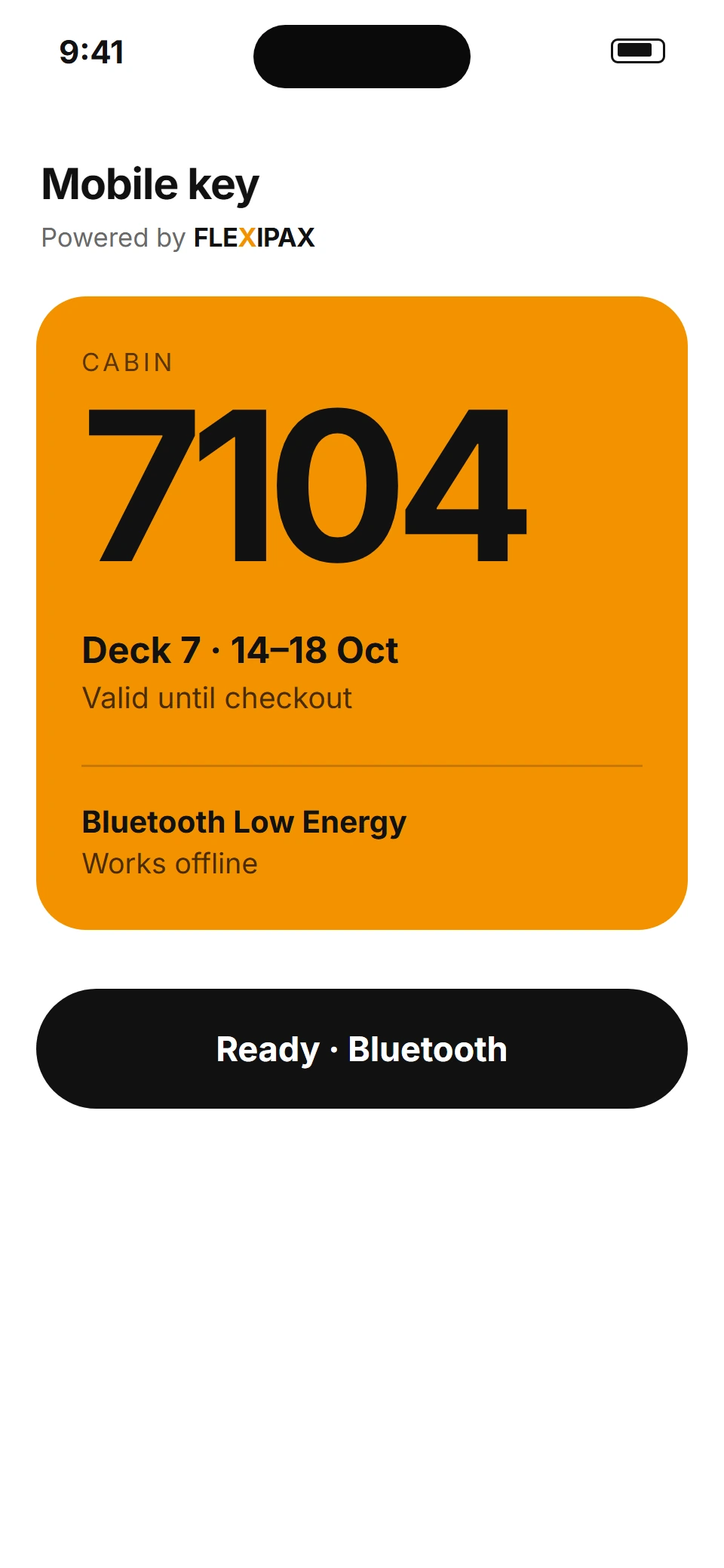
Cabin, deck and dates on one card. Valid until checkout, even offline.
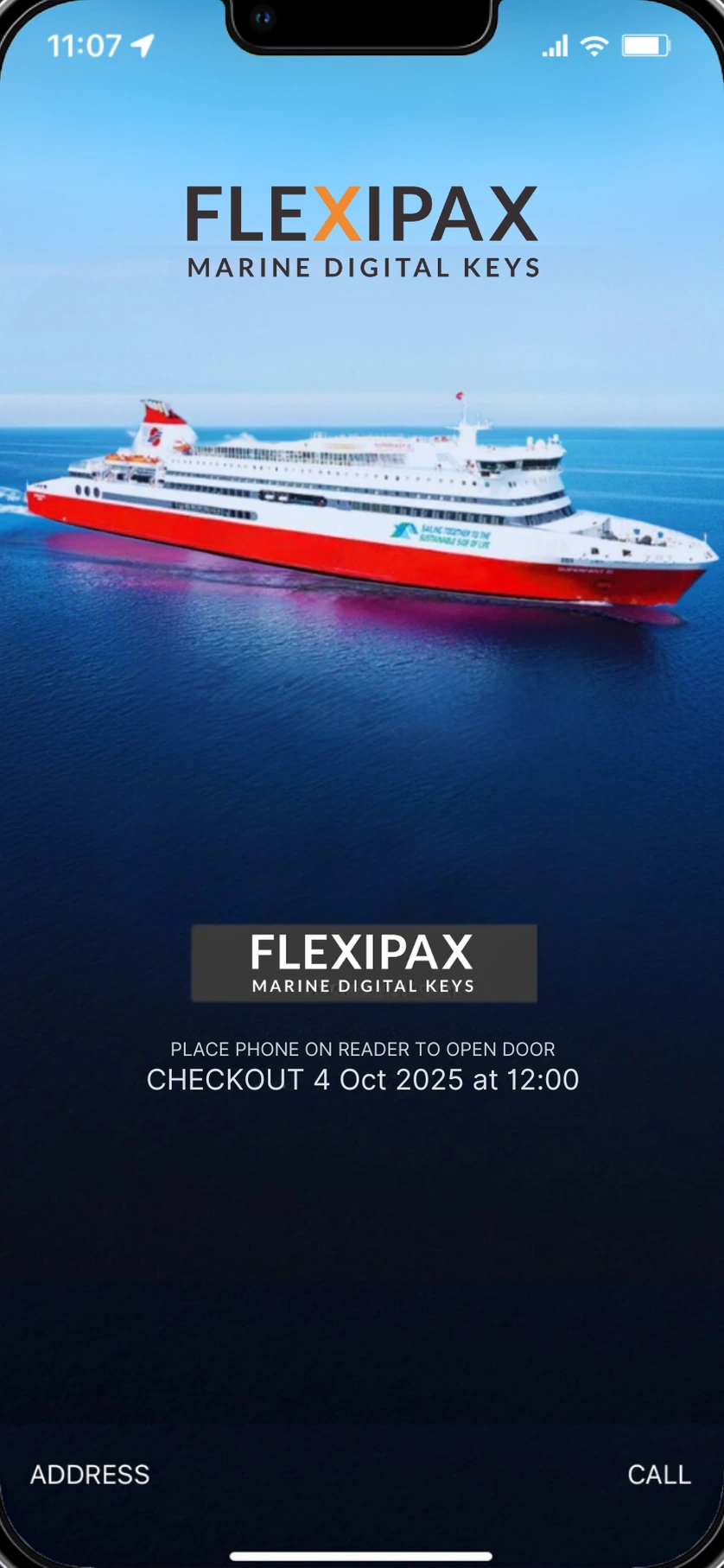
The phone opens the cabin over Bluetooth. No keycard pickup.
| Mobile key | Plastic keycard | |
|---|---|---|
| Where it lives | On the passenger’s phone | On a separate card |
| Getting it | Delivered to the phone, no pickup queue | Collected at reception |
| Lost or damaged | No card to lose or demagnetise | Replaced at reception |
| Cabin change | Updated key over a data connection | New card at reception |
| Families and groups | A unique key per passenger, no limit per cabin | One card per person |
| At sea without internet | Works once downloaded, until checkout | Works |
Both can open the same cabin. Keep keycards at reception for passengers without a usable phone.
Lock brand, model and software decide compatibility. Bluetooth alone isn’t enough.
Lock compatibilityThe FLEXIPAX open API creates and delivers keys from your reservations.
API and SDKThe FLEXIPAX team supports onboarding and training. Keycards stay as a fallback.
Plan your rolloutIn use at Attica Group
FLEXIPAX is intuitive, easy to use, and has significantly helped Attica Group save valuable time while enhancing our guest experience.
A marine mobile cabin key is a digital credential on a passenger smartphone that opens a compatible cabin lock. FLEXIPAX connects mobile cabin access with reservation systems for cruise and ferry operators. The phone communicates with a compatible lock using Bluetooth; a digital boarding pass alone is not a cabin key.
Three ways: inside the operator’s own native passenger app with the FLEXIPAX SDK, in a white-label FLEXIPAX app, or through the Super Fast Brand Experience app. The FLEXIPAX open API connects the reservation system to key creation and delivery.
Once downloaded, a FLEXIPAX mobile cabin key opens its compatible Bluetooth lock without an ongoing data connection until the scheduled checkout date and time. Downloading or updating a key, including after a cabin change, requires a data connection.
FLEXIPAX works with supported Bluetooth lock systems from ASSA ABLOY VingCard, Salto and other providers. Compatibility depends on the manufacturer, model, firmware or door-lock software and available integration; Bluetooth alone does not confirm support.
A mobile key stores the cabin-access credential on a smartphone; a physical keycard carries it on a separate card. Both can be used alongside each other with a compatible setup. Keeping physical keycards available gives passengers a fallback when their phone is unavailable.
FLEXIPAX works with supported Bluetooth lock systems from ASSA ABLOY VingCard, Salto and other providers. Compatibility depends on the manufacturer, model, firmware or door-lock software and available integration; Bluetooth alone does not confirm support. The FLEXIPAX team supports onboarding and training. The FLEXIPAX open API connects internal or external reservation systems to mobile-key creation and delivery; the configured workflow can automatically create a key after embarkation. Keep reception support and physical keycards available for passengers without a usable phone.
FLEXIPAX supports multiple unique mobile keys for the same cabin, alongside physical keycards. FLEXIPAX places no limit on the number of mobile keys per cabin.
A cabin change requires an updated mobile key and a data connection for the relevant lock system, FLEXIPAX service and passenger phone. Without connectivity, reception can provide a physical card for the new cabin. An already-downloaded key remains available for its assigned cabin until its checkout time.
Passengers can download a FLEXIPAX mobile key after departure when a data connection is available and the key is valid for their stay.
A downloaded mobile key cannot be forwarded to another passenger or device. Request a separate unique key for each additional device or passenger.
If a passenger's phone battery runs out, reception can provide a physical keycard as a backup.
Passengers without a smartphone can obtain a physical keycard from reception. Mobile keys and physical keycards can work alongside each other in a compatible setup.
FLEXIPAX can reduce the keycard-pickup queue by delivering a mobile cabin key through the configured booking-system integration. Key creation can be triggered after embarkation. Passengers need a data connection to download the key, and other boarding checks still apply.
A mobile key stores the cabin-access credential on a passenger smartphone, so that passenger does not need to carry a separate plastic keycard. This reduces reliance on cards that can be lost or damaged. Reception can still provide a physical keycard when a phone is unavailable.
FLEXIPAX connects booking systems, mobile-key delivery and compatible cabin locks for cruise and ferry fleets. Review the locks, software, reservation systems and passenger apps on each vessel before agreeing a rollout. Plan cabin changes, reception support and physical-keycard fallback with the operations team.
Share your vessel or fleet size, cabin-lock model, reservation system and passenger app. The demo covers compatibility, API or SDK integration, key delivery and physical-keycard fallback.
Book a marine mobile-key demo